The Liberty style in Cesenatico accompanies the birth of seaside tourism. The “new industry” promoted since 1877, and which would soon become the city's most important resource, encouraged the construction of villas and hotels in Liberty style.
First stop: MUNICIPAL FISH MARKET The first stop will take place in front of the Municipal Fish Market, a historic building part of the important urban redevelopment work between the late 19th century and approximately 1930. Built in 1911, it is an example of a very composed and essential Liberty style. It is a small, single-hall rectangular building, which on its facade features a wide, lowered arch, set on pillars with slightly projecting wide pilasters, enlivened with pyramid motifs. Two medallions with a classicizing and stylized design are visible on either side of the arch. The delicate chromaticism, with white decorative elements on the ivory plaster, also contributes to the sobriety of the ensemble. The building, recently renovated, is still today the main retail location for fresh fish.
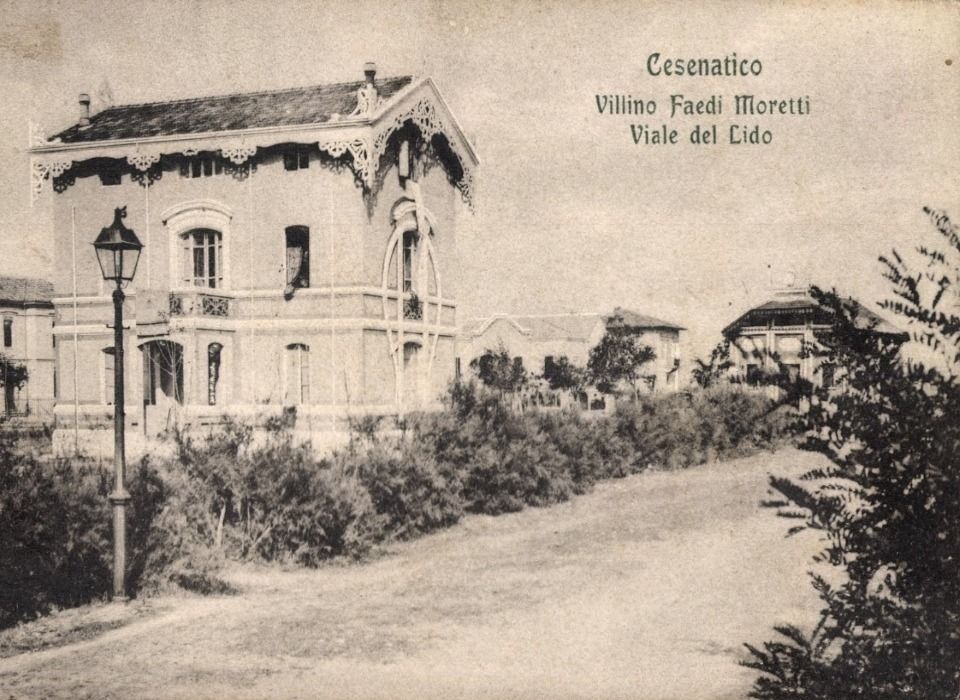
Second stop: VIALE ANITA GARIBALDI (Villa at civic number 14, Villino Hotel Pino, Villa Pompili, Villa Faedi Moretti – destroyed during the war but was a pure example of Liberty style). Continuing from the Municipal Fish Market along Corso Garibaldi towards the sea, you reach the second stop of our “Cesenatico in Liberty” itinerary: Viale Anita Garibaldi. Built in 1894, Viale Anita Garibaldi became the true access road to the beach, and it is on this avenue that the villas built in the early 1900s are still most noticeable today. In this regard, we particularly remember “Villa Rossa” at civic number 14, which dates back to the late 1800s and features Moorish-style arches above the windows, motifs that are echoed in the gate and in the molding between the raised ground floor and the first floor. Opposite is the Liberty villa next to the former Hotel da Pino, which features Floral style decorations such as window profiles with compositions of curved lines, leaves, and fruit garlands. In particular, one can notice the women's heads that, like caryatids, support the cornice beams. Continuing, you reach “Villa Pompili”, built in the early 1900s and recently restored, which still exudes its holiday charm. The first thing one notices is the beautiful wrought-iron gate, a true work of art, as well as the concrete elements featuring floral-style decorations like those above the windows and the entrance door. In Cesenatico, we particularly remember “Villino Faedi Moretti”, built between 1903 and 1905 at the end of Viale Anita Garibaldi, at the corner of Viale Carducci, unfortunately destroyed before the end of World War II. Among the few villas remaining in the area and those immortalized in postcards, Villino Faedi Moretti, with its highly decorated and refined imprint, was the only one in Cesenatico in pure Liberty style.
Third stop: FORMER VERONESE COLONY Where today we find the Grand Hotel Da Vinci, between 1936 and the late 1900s, the structure was a colony that hosted children from the province of Verona for seaside stays. However, between 1920 and 1936, before its transformation into a colony, the annex of Hotel Eritrea stood on that site, designed for the vacationing elite at the dawn of tourism in Cesenatico. This structure initiated a sequence of important accommodation facilities built on the eastern part of the beach along Viale Carducci. It displayed a Secessionist architectural language, characteristic of an architecture that, through its forms, sublimated the exaltation of vacation. It was transformed into a colony in 1936, losing its Liberty characteristics apart from some details such as, for example, the sinuous staircase on Via Piave. In 2006, the building was acquired by a family of entrepreneurs and transformed into a luxury hotel. Fourth stop: Villa Magrini From the Veronese Colony, continuing along Viale Carducci towards the skyscraper at civic number 59, we find a Liberty-style villa still well-preserved today. This is the seaside residence of Adolfo Magrini, an architect who was involved in several local projects. The villa, consisting of two floors, including a raised ground floor, three terraces (two covered on the raised ground floor and one open on the upper floor), has a cleverly articulated volume, and in all compositions, a belvedere turret facing the sea dominates. Adolfo Magrini proposes a neo-medievalism for his villa, characterized by Romanesque and Gothic stylistic elements.
Fifth stop: GRAND HOTEL PIAZZA COSTA A short distance away, you reach Piazza Costa, where the Grand Hotel of Cesenatico stands. Built between 1928 and 1929, it was designed by architect R. Ceccolini. The historic Liberty-style hotel exhibits a sober classicism devoid of cumbersome elements, featuring wide and bright windows, balconies, and two large terraces facing the sea on its facades. Like similar monumental buildings in other European cities, it imitated the residences of great dynasties in its architecture and furnishings. A worldly symbol of an entire era, over the years it has undergone various internal transformations, while maintaining its characteristic Liberty style. During the war, it was occupied by the German Command and subsequently by the Liberation troops as the headquarters of the New Zealand Command. Since 1956, it has been owned by a historic family of hoteliers.
Stagionalità: Autumn, Summer, Spring, Winter
Mandatory reservation: no
Experience accessible: si