Bike itinerary: Cesenatico – Rocca delle Caminate and its wonderful castle
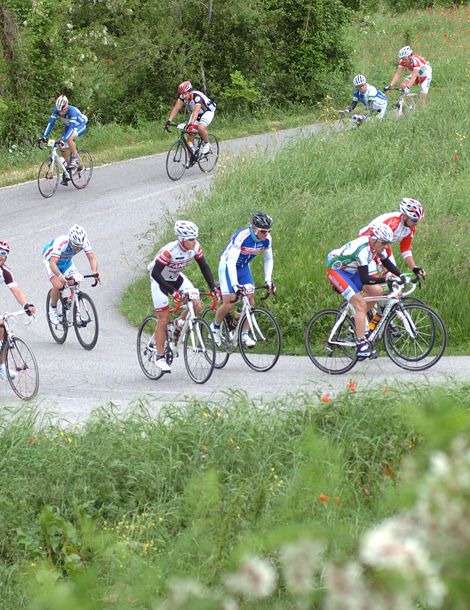
Under the banner of contemporary and ancient history, this itinerary showcases many Romagna beauties and some of its darker sides; in fact, the last stop on the route will be Predappio, the birthplace of Benito Mussolini, the Duce, and Adone Zoli, a Catholic anti-fascist. Near Predappio, you can reach the wonderful castle of Rocca delle Caminate, from where you take the road back home, towards Cesenatico. Get on your bike to enjoy this unique spectacle.
How to do it: recommended itinerary for experienced cyclists, with climbs and long stretches of steep gradients.
Distance: 136 km.
Detailed itinerary: in Cesenatico, take the underpass on Viale Trento and turn right for Cesena, following S.S. 304 to the hamlet of Villalta, then turn right for Pisignano; in Pisignano turn left and continue for Cannuzzo and Matellica; after the Savio river turn left for Mensa; after Mensa turn right (Forlì); cross the E 45 and immediately after, intersect with SS 71; turn left for Cesena and after 200 m. turn right for Forlimpopoli; at the Rocca di Forlimpopoli turn left for Meldola and continue for Civitella and Galeata; from Galeata follow the signs for Strada S.Zeno; in San Zeno, intersect with SS 9 and follow it to Predappio; in the center of Predappio, turn right to climb to Rocca delle Caminate, from where a gentle descent leads back to Meldola; in Meldola turn left for Forlì and then right for Forlimpopoli; take the Via Emilia towards Cesena and after 3.5 km leave it to retrace the same route as the outward journey.
Main stops:
Forlì: the origins of the city, whose name derives from Forum Livi, date back to the 2nd century BC. Around the 10th century, it proclaimed itself a free commune, only to lose its autonomy in the 16th century with its annexation to the Papal States. The protagonist of 19th-century Forlì was Aurelio Saffi, a tireless Mazzinian who fought for the Unification of Italy. The central square, the heart of the city, is dedicated to him, along which the Palazzo Comunale (Town Hall) extends. On the south side are the Palazzo del Podestà and the Palazzina Albertini, while to the east stands the Basilica of S. Mercuriale, a valuable work of Romanesque architecture. Also worth a visit are: the late-Renaissance Vicolo Gaddi, the Oratory of San Sebastiano, the Rocca di Ravaldino, the Municipal Art Gallery, and the Archaeological Museum.
Forlimpopoli: the town was founded by the Romans in the 2nd century BC. Its heart is the Rocca (fortress) built around 1303 by order of Cardinal Albornoz. Trapezoidal in shape, it features mighty walls with four bastions at the corners and currently houses the town hall, the Civic Archaeological Museum, and the Verdi Theater. Also worth a visit are the Church of the Servants and the Collegiate Church of S. Ruffillo.
Meldola: where the center of Meldola stands today, there was a large villa in late antiquity. Excavation campaigns suggest that it was the important residence of a high official of Theodoric. In 1441, it was granted as a fief by the Papal States to Malatesta Novello, lord of Cesena, who surrounded it with walls and fortified the Rocca and the ancient Castle. To visit: the Rocca, the Aldobrandini Loggia, the Town Hall and the Civic Tower, the Collegiate Church of S. Nicola, and the Chapel of the Crucifix.
Civitella di Romagna: the name derives from "Civitatula", a small city, and its origin probably dates back to the 6th century BC. It suffered severe damage due to several earthquakes, but the citizens always managed to rebuild their small city around the ancient castle. In the old town, you can find the Church of S. Maria in Borgo, while the Sanctuary of the Madonna della Suasia houses remarkable works of art.
Galeata: a town of prehistoric origin in a wide valley on the left bank of the Bidente river, whose name seems to derive from the relations the Boii Gauls had with the locality. Roman-era remains are still visible, while the main monument remains the Abbey of S. Ellero, which preserves its Romanesque facade and the crypt containing the sarcophagus of the Patron Saint. Don't miss the Mambrini Museum with its numerous Roman, Byzantine, and medieval artifacts.
Predappio and the Castle of Rocca delle Caminate: the name Predappio is linked to two figures of contemporary history: Benito Mussolini, head of the fascist government, and Adone Zoli, a Catholic anti-fascist, who held important political positions in the Liberation struggle. Inside the cemetery are the tombs of the Zoli and Mussolini families, while a short distance away stands the Romanesque Pieve of San Cassiano in Pennino. In the center of the town, there is a characteristic exedra amphitheater. You can also visit Mussolini's birthplace, the park of the Castle of Rocca delle Caminate, and the architectural complex of S. Rosa. In the nearby village of Predappio Alta, with its clear medieval layout, you will find the fortified Rocca, the Wine Museum, and the ancient sulfur mines, where a characteristic nativity scene is set up during the Christmas period.
To stay updated on all cycling itineraries, check out the experiences of Cesenatico Bike.